
Neighbourhood Governance and the Three - Tier Model: What PCN Leaders Need to Know

At the heart of neighbourhood health is the patient. Everything we’re building – the collaboratives, the federations, the governance structures – exists for one reason: to organise ourselves in a way that allows us to serve our patients better.
This blog isn’t about governance for governance’s sake. It’s about answering a practical question: how do we organise ourselves effectively so we can focus on what matters most as we get ready to deliver neighbourhood contracts
This blog distils a conversation between Tara Humphrey from THC and Ruth Griffiths, Partner at Hill Dickinson, into practical guidance you can use today.
Whether you’re a clinical director, PCN manager, or federation lead, here are some elements you may need to consider when it comes to neighbourhood governance.
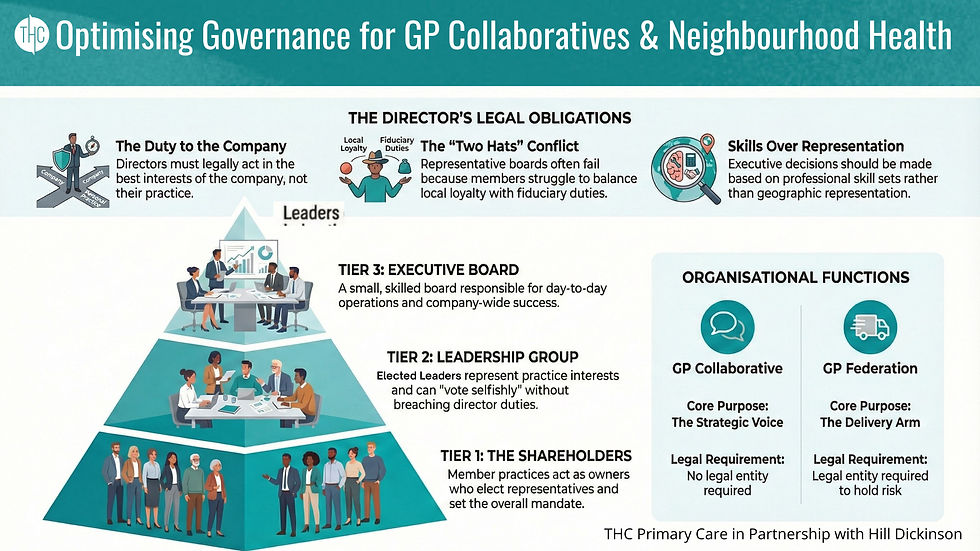
Understanding What It Actually Means to Be a Director
Before we get into models and structures, there’s a fundamental truth many people overlook: being a company director comes with legal duties.
Under statute, directors must act in the best interests of the company – not the practice that nominated them, not the neighbourhood they came from, but the company itself.
Key Director Duties to Remember
Promote the success of the company – Decisions must be made on what’s best for the organisation at scale, not individual practices
Exercise independent judgment – Leave your day job at the door; you’re there for your skills, not as a delegate
Fiduciary duty – The overriding obligation to act in the company’s best interest
The uncomfortable truth: If you’re a director and you consistently vote against the company’s success to protect your practice’s interests, you could be in breach of your duties.
The Problem with Representative Boards
Many federations and PCN collaboratives have created “representative boards” in which every neighbourhood or PCN has a clinical director serving as a director. The intention is good, everyone gets a voice.
But those representatives are wearing two hats; that may not necessarily fit together.
Hat 1: The neighbourhood’s voice (what their practices want)
Hat 2: The company’s director (legally bound to act for the company)
When practices try to hold their “representative” accountable for decisions made at the board level, conflict emerges because that director wasn’t there as their representative. They were there as a company director.
The Three-Tier Governance Model: A Practical Solution
To resolve this tension, Ruth advocates for a three-tier governance structure. Here’s how it works:
Tier 1: Shareholders (Practices)
Your member practices remain the owners. They elect representatives, set the mandates and share their views
Tier 2: Clinical/Neighbourhood Leadership Group
Your clinical directors or neighbourhood leads sit here – not as directors of the company, but as representatives of their practices and neighbourhoods.
Because they’re not bound by director duties, they can vote selfishly. They can represent their practices’ interests. They can push back on decisions without breaching any legal obligations.
Tier 3: Executive/Operational Board
A small, fit-for-purpose board of directors responsible for running the company day-to-day. These people are appointed or recruited for their skills – not to represent anyone. They’re bound by director duties and make decisions in the company’s best interest.
Why This Works
Practices keep their voice through the clinical leadership group
Directors can act freely without being pulled between company duties and practice loyalties
Decisions don’t have to go to 30+ practices every time – just to the leadership group
General practice can still move fast – without creating the same red tape as larger NHS providers
GP Collaborative vs Federation: Do You Need Both?
A common question: if you have a federation, do you also need a GP collaborative?
The honest answer: probably not as separate entities.
When you map out who’s involved, how they meet, and what decisions they make, they’re often one and the same.
The risk of treating them separately is duplication, sending the same people to different meetings, creating competing governance structures, and confusing mandates.
A Clearer Way to Think About It
GP Collaborative = The voice – Strategic influence, representation at system tables, shaping what neighbourhood health could look like (no legal entity required)
Federation = The delivery arm – The legal entity that signs contracts, holds risk, employs staff (legal entity required)
Make sure the terms of reference are consistent with each other. One meeting should be able
to tick both boxes where possible.
The Capacity Problem: Does It Always Have to Be a GP?
General practice doesn’t have tiers of middle management whose day job is attending system meetings. GPs have patients to see.
As contracts come in and meetings ramp up, Ruth posed a provocative question:
Does the representative always have to be a GP?
The answer isn’t about replacing clinical leadership. It’s about recognising that PCN managers, operations directors, and other skilled professionals can represent general practice effectively at many tables, providing consistency, institutional memory, and freeing up clinicians for clinical work.
The ideal end state is having someone whose day job it is to represent you at these meetings. The challenge is funding that role before the contract arrives.
Setting Principles Before the Contracts Arrive
You don’t have to wait for the neighbourhood contracts to get organised. In fact, waiting might leave you behind.
Agree to These Principles Now
Where is a service best delivered? Neighbourhood footprint or place/federation level?
How do decisions flow through your governance? Test your structures with a “sausage machine” approach. If you push something in at the top, does what comes out at the end match what you expected?
What are the reserved matters? Start with tight reins, a longer list of decisions that must go back to the clinical leadership group. As trust builds, you can loosen them
How does information flow back? People go to meetings, but nothing gets reported. Establish clear mechanisms for disseminating what’s discussed
Your Actionable Checklist
Review your current governance structure – is it representative or fit for purpose? If not, why not?
Identify who is wearing director hats vs representative hats. Do they understand the difference?
Audit your meetings, could your GP collaborative and federation governance align to reduce duplication?
Draft or review your principles document, and what are the overarching agreements that guide decision-making?
Map your representation. Who is attending what, with what mandate, and how is information flowing back?
Have the conversation about non-clinical representation where managers could add value at system tables?
The Bottom Line
None of this is about creating perfect governance structures. It’s about clearing the path so we can do what we’re here to do: deliver better care for our patients.
Build on what you have rather than creating parallel structures.
Ensure your governance allows practices to keep their voice while letting directors do their job. And start getting organised now, because others across the country already are.
As Ruth put it: “Even if you’re choosing to wait, make sure you’ve got somebody at those meetings banging a bit of a drum.”
This blog is based on a webinar hosted with Ruth Griffiths, Partner at Hill Dickinson.
About Us
THC Primary Care is an award-winning healthcare consultancy specialising in Primary Care Network Management and the creator of the Business of Healthcare Podcast. With over 20 years in the industry, we've supported more than 200 PCNs through interim management, training, and consultancy.
Our expertise spans project management and business development across both private and public sectors. Our work has been published in the London Journal of Primary Care, and we've authored over 250 blog posts sharing insights on primary care networks.
Check out our facilitation services here: https://www.thcprimarycare.co.uk/primary-care-network-facilitation


.png)

