
Who pays for the NHS left shift? (Why the money isn't following patients out of hospital)

Updated: 1 day ago
At this year's Best Practice Birmingham on 7th and 8th October, Dr Amanda Doyle, NHS England's national director for primary care and community services, told the room that"The left shift isn't happening in practice."
The left shift means moving care, and the money for it, out of hospitals and into primary care, community services and prevention. It sits at the heart of neighbourhood health.
Dr Doyle shared the reason.
"You can take costs out of trusts by taking patients out, but in fact, if they've got deficits and big gaps to make up, the money isn't there to be shifted."
What NHS England has said
Dr Doyle said there is "no huge pot of extra money" from NHS England for ICBs to spend on neighbourhoods, beyond the increases already known.
That doesn't mean there is no neighbourhood funding. Some areas across the country do have funding for neighbourhood work. It just isn't coming from a national pot.
Instead, NHS England will use planning guidance to direct how ICBs spend their existing budgets. The focus is prevention, early intervention, proactive care, and primary and community care.
Work to take apart hospital block contracts is underway, but in Amanda Doyle's words it is "not anywhere near at the scale we need to be."
How one hospital spends its money
To understand why money is hard to move, I looked at one trust's 2025/26 accounts: Bradford Teaching Hospitals NHS Foundation Trust.
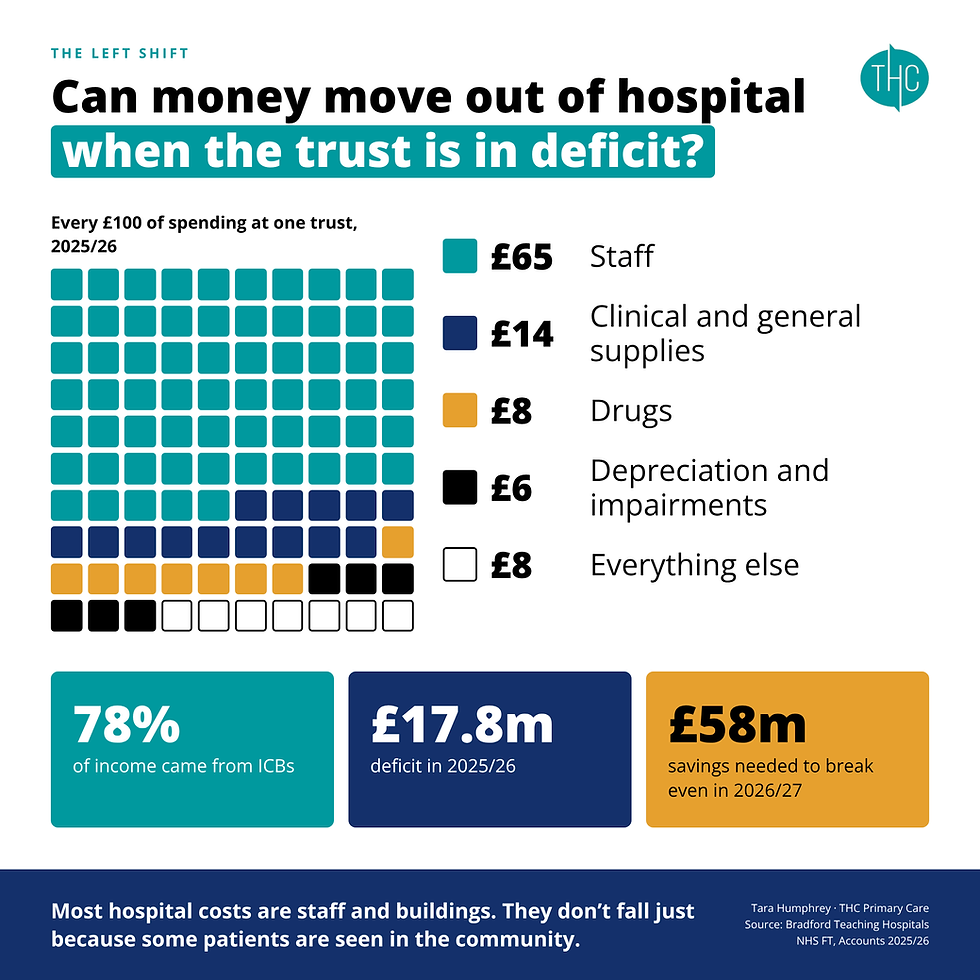
It spent £720m in the year. About £2 in every £3 went on staff. Supplies were around 14% and drugs around 8%.
78% of its income came from ICBs.
The trust planned a £2.7m deficit and ended the year £17.8m in deficit, as agreed with NHS England in a recovery plan. The main reason given was pay, which ran £14.7m over plan.
For 2026/27 it has a break-even plan, which needs £58m of cost improvement savings.
This is one trust, and it is not typical of every hospital. But it shows the problem Dr Doyle described. Most hospital costs are staff and buildings. They do not fall just because some patients are cared for in the community.
The national picture

Nationally, the NHS in England ended 2025/26 £70 million under budget. It was the first time in ten years it met its financial plan without extra money from the Treasury.
But that figure is the total for the whole country. Some areas overspent, and others underspent, and it balanced out.
Hospitals spent around £5 billion more than planned. Most of that was covered by £4.3 billion of extra income. And 15 local health systems still ended the year in deficit, £813 million between them.
A balanced national budget doesn’t help a hospital that is in deficit. That hospital still has to close the gap itself. Until it does, it has no spare money to move into the community.
Can a hospital stay in deficit?
From 2026/27, NHS England's finance rules expect every trust to break even each year. Trusts with an agreed deficit limit receive deficit support funding, but that funding reduces each year. If a trust misses its plan, it loses some of that support.
So under the current rules, a trust cannot simply choose to stay in deficit to invest in the community. It can only plan a deficit with NHS England's agreement.
That leaves the question of how money moves while a trust is working to close its gap.
Why the money is stuck
Paying twice. To move care, the new community service usually has to be funded while the hospital service is still running. This is often called double running. Money only moves out of hospital when capacity, such as a ward, actually closes.
Fixed payments. Block contracts pay a hospital a fixed amount, whatever happens. While that stays the same, fewer patients doesn't mean less money for the hospital. Changing this is under way, but slowly.
Old buildings. The National Audit Office reported in January that many hospital rebuilds have been delayed, some into the 2030s and beyond. Hospitals built with RAAC concrete will not be replaced until 2032-33. DHSC estimates that keeping older hospitals running for longer costs an extra £100 million to £140 million a year.
That is money spent on old buildings that isn't available to move.
The government's 10-year capital plan, published in July, increases capital funding and includes the shift from hospital to community. But Carnall Farrar's analysis notes that most of it is not new money. And capital pays for buildings and equipment, not the staff who run services.
Costs from outside the NHS. Decisions made elsewhere can add costs trusts didn't plan for. This month, NHS Employers and health unions warned that proposed immigration changes could cost NHS organisations at least £169 million. The proposals are not final. But costs like these land on trusts that are already working to break even.
Where could the money come from?
Growth money. ICB budgets rise each year. ICBs could give a bigger share of that increase to primary and community care, rather than taking money away from hospitals. But hospitals in deficit will also be asking for that growth.
Slower growth in hospital spending. The left shift might never take money out of a hospital budget. It might mean hospital spending grows more slowly than it would have.
Local schemes. Some areas already have schemes that pay general practice for same-day access, proactive care, and home visiting. From the outside, it is hard to tell whether this is new money or existing money repackaged. If it is new, where has it come from?
Care is moving anyway
There are two kinds of left shift. Care can move without money moving. Moving money out of hospital budgets is a different question, and in some areas, while trusts work to break even, that money may not be freed up.
But some places are funding care closer to home.
Dr Doyle pointed to varying the PCN DES as a tool available now. So far, Kent and Medway is the only ICB to have done this. All 140 practices signed up. The ICB describes it as nearly £10 million of new annual investment in proactive care for about 92,000 people, including care home residents, people on palliative care registers, and housebound people with severe frailty.
Buckinghamshire Healthcare NHS Trust is moving £325,000 directly to 12 GP practices, through a GP Capacity and Outcomes Fund developed with the local primary care collaborative and the LMC.
Buckinghamshire's plan for 2025/26 was a deficit of just £0.8m, with around £12.4m of deficit support funding coming through its local system. It says it delivered that plan for the third year running, with £37.9m in efficiencies.
Compare that with Bradford, which ended the same year with a £17.8m deficit and needs to save £58m this year just to break even.
The consultation on the new single-neighbourhood and multi-neighbourhood provider contracts received more than 1,000 responses and is still being analysed.
Dr Doyle said she does not want people "sat back waiting for a new contract", but if the money can’t follow the patient, how do we make the left shift real?
Facilitation Support
If your network would benefit from a neutral voice for those tricky discussions, we provide in-person facilitation.
Contact admin@thcprimarycare.co.uk to discuss the support you may need.
On the podcast

Newsletter


